
Proprietary Project Management Platform for Engineering Teams
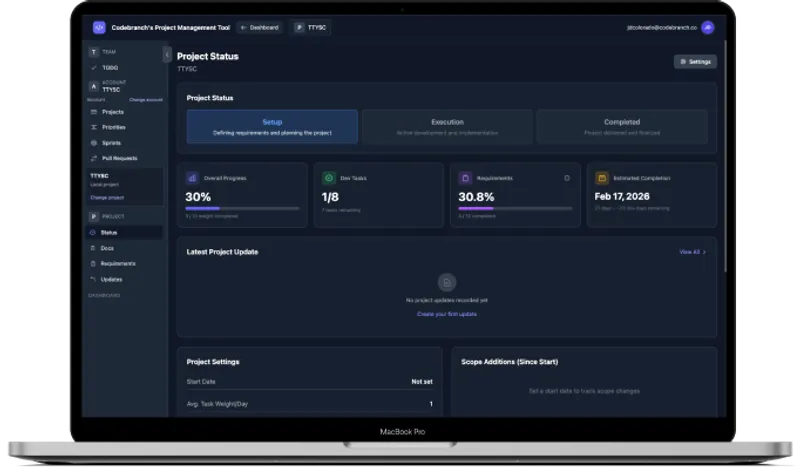
CodeBranch's Project Management Platform is an internal, proprietary system designed to standardize how software projects are planned, executed, and monitored across multiple teams and clients. It replaces flexible but inconsistent tools with a unified execution framework that connects requirements, development, QA, and real code activity in one system.
Why We Built Our Own Project Management Platform
As CodeBranch scaled, managing multiple projects with generic tools introduced operational variability, inconsistent workflows, and limited visibility.
The platform was built to:
- Enforce standardized execution across all projects
- Reduce manual reporting and administrative overhead
- Improve auditability and cross-project analysis
- Enable data-driven decision making
Key Features
Unified Dashboard Across All Projects
The platform provides a single dashboard that aggregates tasks from multiple projects, allowing:
- • Project Managers to oversee several initiatives simultaneously without context switching
- • Developers to see prioritized work and workload in real time
- • Leadership to track progress and workload in real time
Benefit: This eliminates fragmented views and disconnected documentation.
AI-Assisted Requirements & Acceptance Criteria
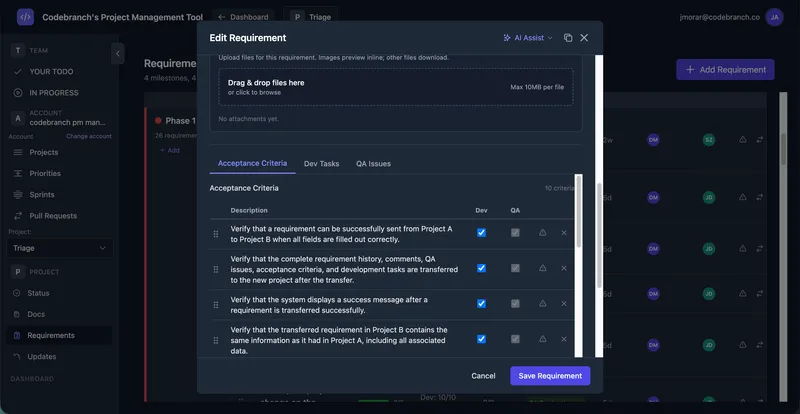
Artificial Intelligence is integrated to support Project Managers by:
- • Improving requirement clarity and structure
- • Generating and refining acceptance criteria
- • Scoring requirement completeness and quality
- • Identifying gaps before development begins
Benefit: This reduces ambiguity and accelerates development cycles.
Requirements, QA, and Development Fully Connected
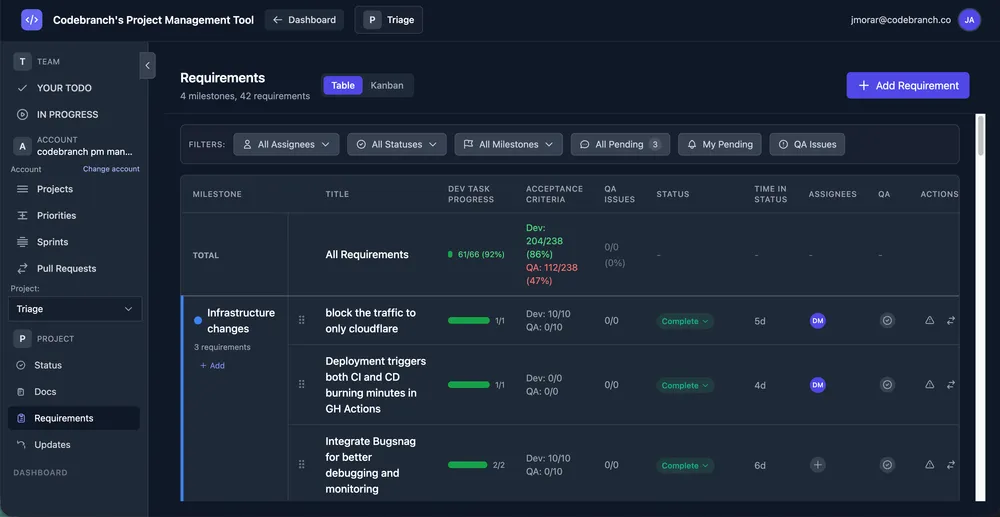
Each requirement is directly linked to:
- • Acceptance criteria
- • Development tasks
- • QA validation tickets
Benefit: QA findings can be traced to specific acceptance criteria, creating full traceability from planning to validation.
Reporting Based on Real Code Activity
Unlike traditional PM tools, reporting is generated from actual development activity, including:
- • Pull requests
- • Code changes linked to requirements
- • Delivery velocity by sprint and developer
Benefit: This provides objective progress tracking and early risk detection.
Prioritization, Capacity & Runway Visibility
The platform includes:
- • Task prioritization by project and individual
- • Developer workload visibility
- • "Runway" indicators showing days of assigned work
Benefit: This ensures execution order is clear and sustainable.
Requirements Tracking
Standardization Without Micromanagement
The platform does not replace Project Managers or developers. Instead, it:
- Automates low-value administrative work
- Reduces cognitive load
- Improves auditing and oversight
- Preserves human decision making
Cross-Project Intelligence & Continuous Improvement
Standardized execution enables CodeBranch to:
- Compare similar projects
- Detect systemic delivery issues
- Apply improvements across teams
- Continuously refine execution processes
AI-Assisted Requirements
Every Requirement Linked to Acceptance Criteria, Dev Tasks & QA
The platform connects every requirement to its acceptance criteria, development tasks, and QA validation — creating full traceability from planning to delivery.
Benefits for Clients
Clients benefit from:
- Predictable delivery timelines
- Consistent quality standards
- Clear project visibility
- Reduced execution risk
- Simplified audits and reporting
This platform is a core component of how we operate our dedicated development teams , ensuring consistent execution, clear ownership, and predictable delivery across all client engagements.
This execution framework is already being used across real client engagements. Explore how our teams apply standardized delivery in real-world case studies.
FAQ
What makes CodeBranch's project management platform different?
Does the platform replace project managers?
How does AI help in project management?
Can the platform manage multiple projects at once?
See Our Platform in Action
Start a project with CodeBranch and experience standardized, transparent software delivery.