Skip to content
Supply Chain

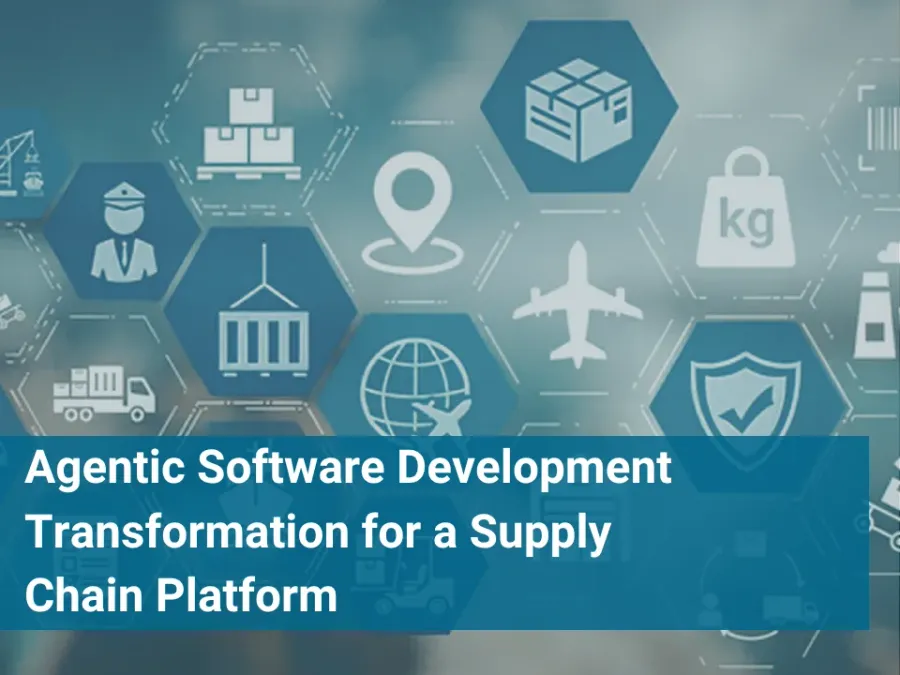
Agentic Software Development Transformation for a Supply Chain Platform

How an AI agent-driven methodology delivered 5x development velocity and 4x design speed for a supply chain AI platform in the semiconductor industry.

Quick Summary

  • CodeBranch led the transformation of a development team to an AI agent-driven methodology for a supply chain AI assistant in the semiconductor industry, achieving 5x development velocity and 4x design speed within six weeks.
  • Achieved a 5x increase in development velocity, with a projection to reach 10x.
  • Achieved a 4x increase in design velocity through functional prototyping with AI agents.
Tech Stack: React Next.js Nest.js FastAPI Python PostgreSQL LLaMA Claude Codex
AI Agent-Driven Development Transformation for Supply Chain

Overview

This case study documents the transformation of a six-person development team from a traditional AI-assisted workflow to a fully agent-driven development methodology. The project — an AI agent designed to assist supply chain planners in the semiconductor and hardware industry — served as the proving ground for a methodology where developers, designers, and QA analysts shifted their roles from hands-on execution to guiding, orchestrating, and auditing AI agents. The transformation was executed in four phases over six weeks, covering project management tooling, development pipeline automation, design integration, and QA automation.

Industries

Supply Chain Semiconductor

Services Provided

  • AI Development
  • Custom Software Development
  • Dedicated Team

Approach

The project was delivered by a six-person team: a UX/UI Designer, a QA Specialist, two Developers, a Project Manager, and a Software Architect. Claude (Anthropic) and Codex (OpenAI) served as the primary AI agents, supported by a proprietary project management tool and specialized auditing tools integrated into the pipeline. The transformation followed four phases: project management migration, closed-loop development pipeline, agent-driven design, and automated end-to-end QA.

1x UX/UI Designer
1x QA Specialist
2x Developer
1x Project Manager
1x Software Architect

Results

  • Achieved a 5x increase in development velocity, with a projection to reach 10x.
  • Achieved a 4x increase in design velocity through functional prototyping with AI agents.
  • Reduced QA rejections through automated auditing and closed-loop pipelines.
  • Enabled the team to work on multiple requirements in parallel instead of sequentially.
  • Exceeded the initial hypothesis of 2x–3x acceleration within six weeks of implementation.
  • Improved team autonomy, product ownership, and proactive contribution to the product roadmap.
Frequently Asked Questions

What was the starting point before the transformation?
The team operated with a traditional AI-assisted workflow where developers reviewed every line of AI-generated code manually. Designers created static mockups in Figma through a sequential process. QA testing was entirely manual on a staging environment. The team worked one requirement at a time, creating bottlenecks.
What does the closed-loop development pipeline do?
All code generated by AI agents is automatically audited for quality, architectural alignment, and security before reaching human review. This eliminates the need for developers to review every line of code manually and ensures consistent quality standards across the codebase.
How did the design process change?
The designer shifted from producing static Figma mockups to guiding AI agents in building functional prototypes. Once approved by the client, the prototype branches are handed to the development team to connect to the backend — drastically accelerating the design approval cycle.
What was the biggest challenge during the transformation?
The primary challenge was adapting the team to work on multiple requirements in parallel simultaneously — a significant shift from the previous one-at-a-time workflow. Additionally, developers experienced an emotional impact from no longer writing code directly, which required personalized coaching to help them embrace their new role as agent orchestrators.
What role does daily follow-up play?
Daily follow-up proved to be critical and non-negotiable. When follow-up was interrupted, team performance decreased notably. Active leadership presence and continuous coaching are essential factors for sustaining the transformation results.
What results were achieved in six weeks?
The team achieved a 5x increase in development velocity and a 4x increase in design velocity, exceeding the initial hypothesis of 2x–3x. Based on early results, the projection is to reach 10x relative to the starting point. QA rejections decreased through automated auditing, and the team shifted to working multiple requirements in parallel.
What are the three pillars that sustain the transformation?
First, continuous research and innovation in the pipeline — keeping the methodology competitive with new tools and auditing improvements. Second, measurement, follow-up, and continuous coaching — daily tracking and personalized support are non-negotiable. Third, proactive product backlog management — the increased velocity demands that the Product Owner maintains a sufficient runway of high-impact work.

Related Case Studies

Ready to Build Something Great?

Let's discuss your project and find the perfect solution for your business.